
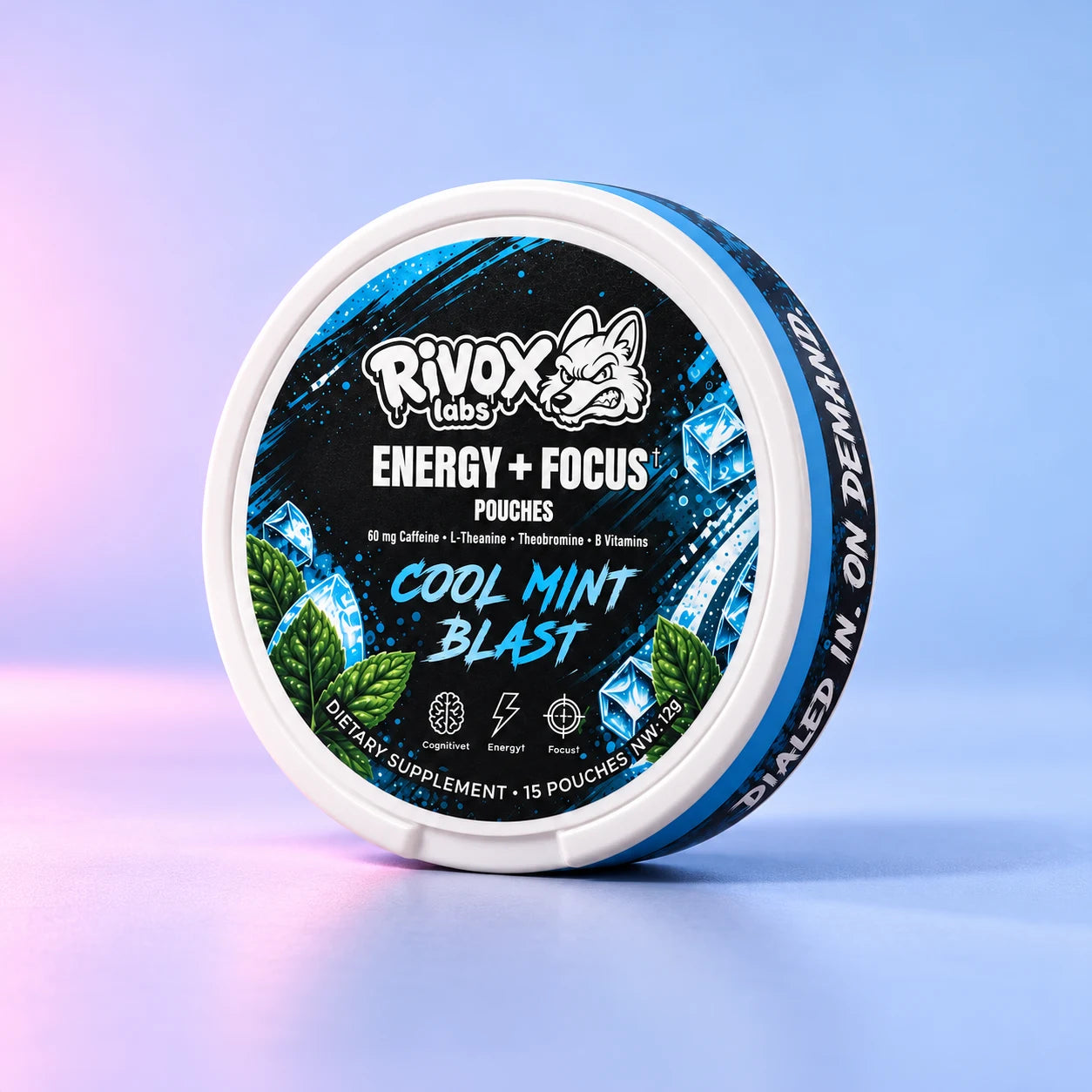
Per pouch · 15 pouches per tin
FOCUS POUCHES
A pouch that sits between your upper lip and gum. Caffeine, L-theanine, theobromine and B vitamins.
60MG CAFFEINE
- Caffeine
- 60 mg
- L-theanine
- 75 mg
- Theobromine
- 50 mg
- Vitamin B6
- 2 mg
- Vitamin B12
- 100 mcg
THE SCIENCE
What’s in it. How much. What the research does, and doesn’t, say.

Clear amounts. Separate formulas. Zero nicotine.
INSIDE RIVOX
A pouch and a piece of gum have different ingredient lineups. Here’s the amount in one serving of each.
Per pouch · 15 pouches per tin
A pouch that sits between your upper lip and gum. Caffeine, L-theanine, theobromine and B vitamins.
Per piece · 54 pieces per box
A familiar peppermint chew. Caffeine, Alpha-GPC and B vitamins in a pocketable format.
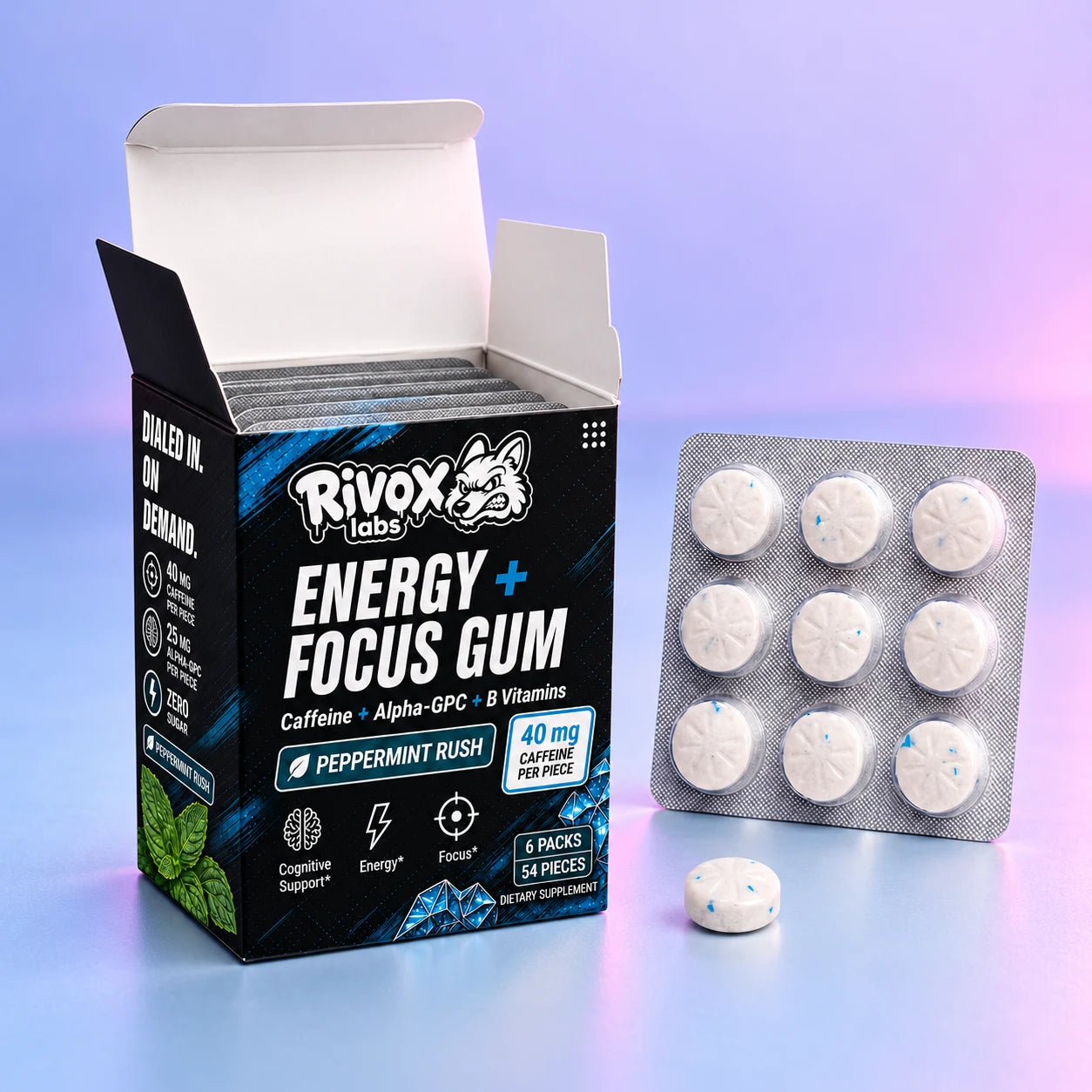
Amounts reflect the current formula information. Check your physical product label for complete ingredients, directions and warnings.
WHAT’S DOING WHAT

Both formats · 60 mg / 40 mg
A stimulant found in both formats. A controlled study of 60 mg oral caffeine reported improved sustained attention and alertness in healthy adults. That is ingredient research, not a trial of Rivox.

Pouches · 75 mg
An amino acid found in tea. Researchers have studied it alongside caffeine for attention. The studied combinations differ from Rivox’s 60 mg caffeine + 75 mg L-theanine formula.

Pouches · 50 mg
A compound naturally present in cacao and related to caffeine. Each Rivox pouch contains 50 mg. The research notes below explain the doses studied and what the findings mean.
Gum · 25 mg
A source of choline, which the body uses to make acetylcholine, a neurotransmitter involved in memory and muscle control. Each piece of Rivox gum contains 25 mg. This does not establish a cognitive benefit from the amount in Rivox gum.

Both formats · See amounts above
B6 participates in neurotransmitter synthesis. B12 supports normal nervous-system function and red blood cell formation. These supporting nutrients are not a substitute for sleep. Supplementation does not necessarily improve energy or performance when nutrient status is adequate.
Natural-source images illustrate where some ingredients occur. They do not describe the source of the ingredients in Rivox.
SHOW YOUR WORK
These studies tested ingredients or other formulations, not finished Rivox products. The doses, formats and people studied matter. Here’s the context.
In 82 healthy adults aged 40–60 who consumed little or no caffeine, a randomized study evaluated 60 mg of oral caffeine and reported better sustained attention and alertness.
Rivox pouches contain 60 mg caffeine and gum contains 40 mg per piece. This study tested caffeine, not either finished Rivox product.
The study compared 50 mg caffeine, with and without 100 mg L-theanine. The combination improved selected measures of attention and resistance to distraction.
Rivox pouches contain 60 mg caffeine + 75 mg L-theanine. The study did not test that combination, dose ratio or pouch format.
Researchers compared caffeinated gum with capsules at doses of 50, 100 and 200 mg. The studied gum reached peak blood caffeine levels sooner on average.
The study used another gum formulation. It does not establish the onset or absorption rate of Rivox’s 40 mg piece.
In 80 healthy participants, researchers studied 250, 500 and 1,000 mg of theobromine. Effects at 250 mg were limited; higher doses produced negative mood effects. Rivox pouches contain 50 mg, below the tested range.
We do not use those results to promise extended focus, a specific duration, or prevention of a caffeine crash.

SCIENCE HAS PEOPLE BEHIND IT
Our co-founder is an exercise physiologist and published researcher. Get to know his background and the perspective he brings to Rivox.
Meet JoshNo. Both formats contain caffeine. Pouches contain 60 mg per pouch; gum contains 40 mg per piece.
The studies linked here examine individual ingredients or other formulations. They do not test the finished Rivox formulas. Each research note explains the study dose and how it compares with our products.
Count caffeine from every source, including coffee, drinks, pouches and gum. Follow each product’s label and consider your own caffeine sensitivity. Ask a qualified healthcare professional if you are unsure what is appropriate for you.
Each product page includes its ingredient information and directions. Your physical packaging has the complete label for the product you have.
NOW YOU KNOW WHAT’S INSIDE
Choose your format. Read its label. Keep caffeine from every source in the count.
FIND YOUR EVERYDAY CARRYContains caffeine. Adults only. Follow the directions and warnings on your product label. Count caffeine from all sources.
*These statements have not been evaluated by the Food and Drug Administration. These products are not intended to diagnose, treat, cure, or prevent any disease.
 United States
|
USD
$
You are currently shipping to United States and your order will be billed in USD $.
 Australia
AUD
$
 Austria
EUR
€
 Belgium
EUR
€
 Canada
CAD
$
 Czechia
CZK
Kč
 Denmark
DKK
kr.
 Finland
EUR
€
 France
EUR
€
 Germany
EUR
€
 Hong Kong SAR
HKD
$
 Ireland
EUR
€
 Israel
ILS
₪
 Italy
EUR
€
 Japan
JPY
¥
 Malaysia
MYR
RM
 Netherlands
EUR
€
 New Zealand
NZD
$
 Norway
USD
$
 Poland
PLN
zł
 Portugal
EUR
€
 Singapore
SGD
$
 South Korea
KRW
₩
 Spain
EUR
€
 Sweden
SEK
kr
 Switzerland
CHF
CHF
 United Arab Emirates
AED
د.إ
 United Kingdom
GBP
£