
Articles and Education
Do I Have Low Testosterone? Symptoms, Testing, and What Your Results Mean
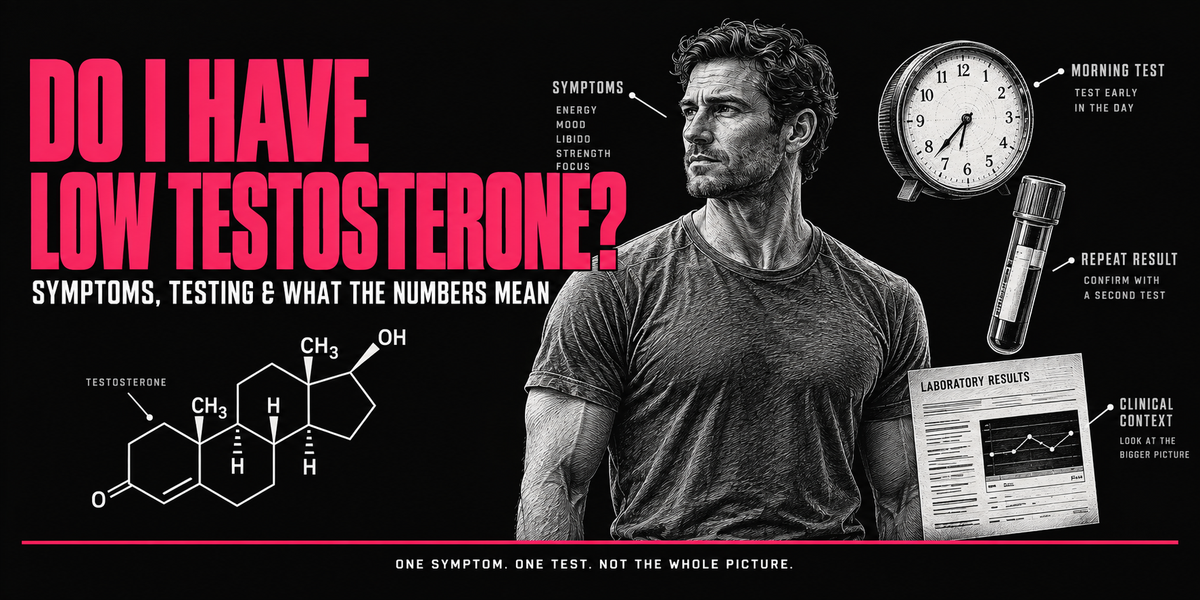

Your energy is off. Training feels flat. Motivation is harder to find, and you do not feel quite like yourself.
It is easy to put those experiences into one bucket: low testosterone. The problem is that the body rarely makes diagnosis that simple.
Fatigue, low mood, reduced strength, weight gain, poor concentration, and disrupted sleep can occur with testosterone deficiency. They can also occur for many other reasons. Even a laboratory result below a reference range is not automatically a diagnosis.
Major clinical guidelines take a more careful approach. Testosterone deficiency is generally identified when a man has compatible symptoms or signs and consistently low testosterone on properly collected tests. The symptoms, measurements, testing conditions, and possible cause all matter. [1–3]
The quick take
- No single symptom proves that testosterone is low.
- Sexual symptoms—especially reduced libido and fewer spontaneous or morning erections—tend to be more informative than fatigue alone.
- A low result is usually confirmed with a second early-morning measurement under appropriate conditions.
- Total testosterone is the starting point, but SHBG and free testosterone can add context in selected cases.
- Sleep, obesity, illness, underfueling, medication, and prior anabolic-steroid use can affect testosterone or mimic related symptoms.
- A dietary supplement cannot diagnose or treat hypogonadism and should not replace medical evaluation.
What does “low testosterone” actually mean?
People often use “low T” to describe a collection of frustrating experiences: less energy, lower sex drive, slower progress in the gym, more body fat, or simply feeling older. Clinically, testosterone deficiency—also called male hypogonadism—is more specific.
The Endocrine Society recommends diagnosing hypogonadism only in men with relevant symptoms or signs and testosterone concentrations that are unequivocally and consistently low. The American Urological Association and European Association of Urology use the same basic combination: clinical features plus confirmed biochemical evidence. [1–3]
That distinction protects against two errors. The first is assuming ordinary fatigue proves a hormone problem. The second is dismissing meaningful symptoms because one result happened to fall inside a laboratory range.

Which symptoms are more informative?
The European Male Ageing Study examined symptoms and hormone measurements in a large community sample of middle-aged and older men. Sexual symptoms—reduced morning erections, reduced sexual thoughts, and erectile dysfunction—showed the clearest relationship with low testosterone when they occurred together. Many physical and psychological complaints were common but less specific. [4]
That does not mean sexual symptoms automatically equal testosterone deficiency. Erectile function, for example, can be affected by vascular health, diabetes, medication, psychological factors, sleep, and relationship context. It means these symptoms may provide a stronger reason to discuss evaluation than a vague sense of being tired.
| Potentially more informative | Common but less specific |
|---|---|
| Reduced libido | Fatigue or low energy |
| Fewer spontaneous or morning erections | Low motivation or low mood |
| Sexual symptoms occurring together | Difficulty concentrating |
| Infertility or testicular changes | Reduced gym performance |
| Hot flashes or loss of body hair in a compatible clinical setting | Weight gain or reduced muscle mass |
Patterns matter. A clinician will also consider when symptoms began, whether they are persistent, how much they affect daily life, and what else changed around the same time.
Why one testosterone test is usually not enough
Testosterone is not a fixed number. Concentrations vary across the day and can shift with sleep, food intake, illness, and normal biological and laboratory variation.
Guidelines therefore recommend measuring total testosterone in the early morning, when levels are generally higher, and confirming an unexpectedly low result on a separate day. The Endocrine Society and European guidance also emphasize fasting measurements. For night-shift workers, the timing may need to follow the main sleep period rather than a conventional clock time. [1, 3]

Conditions that can complicate a result
Testing during an acute illness can produce a result that does not represent your usual state. Marked sleep disruption, aggressive calorie restriction, heavy training without adequate recovery, obesity, and certain medications can also affect the hormone system or its interpretation.
Tell the clinician reviewing the result about prescription drugs, supplements, opioids, glucocorticoids, fertility goals, and current or past anabolic-steroid use. Do not discontinue prescribed medication simply to change a laboratory value.
Total testosterone, free testosterone, and SHBG
Total testosterone includes testosterone circulating in several forms. Most is carried by proteins—primarily sex hormone-binding globulin, or SHBG, and albumin. A small fraction circulates unbound and is called free testosterone.
Total testosterone is usually the first measurement because it is better standardized and widely available. But SHBG can alter how a total value should be understood. If SHBG is unusually high or low, two men with the same total testosterone may not have the same estimated free testosterone.

Obesity, insulin resistance, and hypothyroidism can be associated with lower SHBG. Aging, hyperthyroidism, some liver conditions, and certain medications can raise it. When total testosterone is near the lower limit or a condition that changes SHBG is present, guidelines recommend considering free testosterone using a reliable method. [1, 3]
Method matters. Direct free-testosterone immunoassays are generally not recommended. Free testosterone may instead be measured by equilibrium dialysis or calculated from total testosterone, SHBG, and albumin. Even then, the result belongs inside the broader clinical picture—not above it.
So what number counts as low?
There is no single number that every organization and laboratory uses in exactly the same way.
The AUA uses total testosterone below 300 ng/dL as a reasonable cutoff supporting diagnosis, while still requiring symptoms or signs and two early-morning measurements. Current European guidance uses 12 nmol/L—about 346 ng/dL—as a diagnostic threshold in symptomatic men and notes that treatment effects tend to be greater with more marked deficiency. The Endocrine Society emphasizes an accurate lower limit for the assay and reference range being used rather than treating one universal cutoff as self-sufficient. [1–3]
Laboratory reference ranges also differ because assays and reference populations differ. A harmonization study using standardized measurements estimated a reference range of approximately 264–916 ng/dL in healthy, non-obese men aged 19–39, but that research range was not designed to diagnose every man across every age and clinical situation. [5]
A cutoff helps organize clinical decisions. It does not replace symptoms, repeat testing, assay quality, health history, or professional interpretation.
Finding the cause matters
Testosterone production depends on communication between the brain and testes. The hypothalamus and pituitary signal the testes through hormones that include luteinizing hormone, or LH, and follicle-stimulating hormone, or FSH.
Primary hypogonadism begins at the testes. Testosterone is low while LH and FSH may rise because the pituitary is sending a stronger signal.
Secondary hypogonadism involves inadequate signaling from the hypothalamus or pituitary. Testosterone is low while LH and FSH are low or inappropriately normal.
Functional hypogonadism describes potentially reversible suppression associated with factors such as obesity, significant illness, or certain medications after classical structural causes have been considered. The terminology is still debated, but the practical point is straightforward: the same testosterone result can arise through different pathways. [3]
That is why clinicians may add LH, FSH, prolactin, SHBG, or other targeted testing instead of moving directly from one low result to treatment.
When to speak with a healthcare professional
Consider evaluation when symptoms are persistent, unexplained, or meaningfully affecting sexual health, fertility, physical function, mood, or daily life. Mention:
- A persistent reduction in libido or spontaneous erections
- Fertility concerns, testicular changes, or loss of body hair
- Hot flashes, breast enlargement, or breast tenderness
- Unexplained fractures or reduced bone density
- Persistent fatigue, low mood, weakness, or reduced function
- Opioid or glucocorticoid use
- Current or previous anabolic-steroid use
- Headaches or changes in vision occurring with hormonal symptoms
Headache and visual changes can sometimes point toward a pituitary problem and deserve timely evaluation, especially when accompanied by other hormonal findings. Sudden severe headache, major visual loss, weakness on one side, chest pain, fainting, or other acute symptoms require urgent medical attention.
Support is not the same as treatment
Healthy testosterone physiology exists inside a larger system. Consistent sleep, adequate nutrition, resistance training, recovery, weight management where appropriate, and responsible alcohol use can support general health. Addressing a reversible contributor may also change hormone measurements in some men.
A dietary supplement occupies a different category from prescription testosterone therapy. It cannot diagnose testosterone deficiency, determine its cause, or replace treatment for a confirmed medical condition. Prescription testosterone also requires individual risk–benefit assessment and can suppress sperm production, making fertility goals particularly important to discuss. [1, 2]
Where No Curfew fits
No Curfew was developed for adult men who want to support healthy testosterone physiology as part of a broader performance and lifestyle routine.
That positioning has boundaries. No Curfew is not a testosterone test, does not diagnose hypogonadism, and is not a substitute for medical evaluation. The evidence for individual ingredients must also be interpreted according to the specific extract, dose, population, duration, and outcome studied; results from separate ingredients cannot simply be added together to predict the effect of a finished formula.
The role of a responsible testosterone-support product is to complement the fundamentals—not encourage you to ignore persistent symptoms or chase a number without context.
Support the foundation. Understand the signal. Keep showing up for what comes next.
A practical next-step framework
- Name the symptom. Be more specific than “I feel off.” Note changes in sexual function, energy, mood, strength, sleep, and recovery.
- Look for the pattern. Record when it began, whether it is persistent, and what changed in your health, medication, training, food intake, or sleep.
- Discuss appropriate testing. Symptoms and history should guide the decision—not an online checklist alone.
- Test under appropriate conditions. Morning measurement is standard for most men; shift workers may need timing based on sleep.
- Confirm a low result. One measurement can be affected by ordinary variation or temporary conditions.
- Interpret more than the number. Consider the assay, reference range, SHBG, free testosterone when indicated, and the possible cause.
- Address the actual problem. A supplement, lifestyle change, or medical treatment should match the evidence and the individual situation.
Frequently asked questions
Can I tell that my testosterone is low from my symptoms?
No symptom can confirm low testosterone. Sexual symptoms may be more informative than fatigue or poor motivation, but diagnosis still requires appropriate laboratory testing and clinical interpretation.
What time should testosterone be tested?
For most men, guidelines recommend an early-morning measurement, often between 7:00 and 10:00 a.m. Shift workers may need testing after an adequate main sleep period rather than according to conventional morning hours.
Is one low testosterone result enough?
Usually not. A low result is generally repeated on a separate day because testosterone varies and can be temporarily affected by testing conditions, sleep, food intake, and illness.
Is free testosterone more important than total testosterone?
Not automatically. Total testosterone is typically the initial test. Free testosterone can add useful context when total testosterone is borderline or SHBG is likely to be altered, but the method used to measure or calculate it matters.
Does a testosterone level below 300 ng/dL mean I need treatment?
No. The AUA uses 300 ng/dL as a cutoff that can support diagnosis, but compatible symptoms, two early-morning measurements, evaluation of the cause, fertility plans, and an individual risk–benefit discussion still matter.
Can No Curfew treat low testosterone?
No Curfew is a dietary supplement intended to support healthy testosterone physiology. It is not intended to diagnose, treat, cure, or prevent testosterone deficiency, hypogonadism, or any disease.
This article is for educational purposes and is not medical advice. Rivox products are not intended to diagnose, treat, cure, or prevent any disease. Consult a qualified healthcare professional about persistent symptoms, laboratory testing, fertility concerns, and supplement use, particularly if you take medication or have a medical condition.
About the Author
Josh Avila, Ph.D.
Exercise Physiologist · Published Researcher · Partner at Rivox Labs
Josh Avila, Ph.D. is an exercise physiologist and published researcher whose academic work spans exercise genetics, resistance training, body composition, vascular physiology, trauma biology, inflammation, and physiological adaptation. At Rivox Labs, he helps translate complex scientific and regulatory literature into accessible, research-informed articles about human performance, focus, energy, and supplement science.
References
- Bhasin S, et al. Testosterone Therapy in Men With Hypogonadism: An Endocrine Society Clinical Practice Guideline. Journal of Clinical Endocrinology & Metabolism. 2018;103(5):1715–1744. PubMed.
- Mulhall JP, et al. Evaluation and Management of Testosterone Deficiency: AUA Guideline. Journal of Urology. 2018;200(2):423–432. PubMed.
- European Association of Urology. Male Hypogonadism. EAU Guidelines on Sexual and Reproductive Health. Current online edition. Read guideline.
- Wu FCW, et al. Identification of Late-Onset Hypogonadism in Middle-Aged and Elderly Men. New England Journal of Medicine. 2010;363:123–135. PubMed.
- Travison TG, et al. Harmonized Reference Ranges for Circulating Testosterone Levels in Men of Four Cohort Studies in the United States and Europe. Journal of Clinical Endocrinology & Metabolism. 2017;102(4):1161–1173. PubMed.
- U.S. Food and Drug Administration. Structure/Function Claims. FDA.


